Indonesia Moves Closer to Operating Its First Aircraft Carrier
Indonesia prepares sailors and upgrades for the transfer of Italy’s Giuseppe Garibaldi, marking its first-ever aircraft carrier acquisition.
 editor
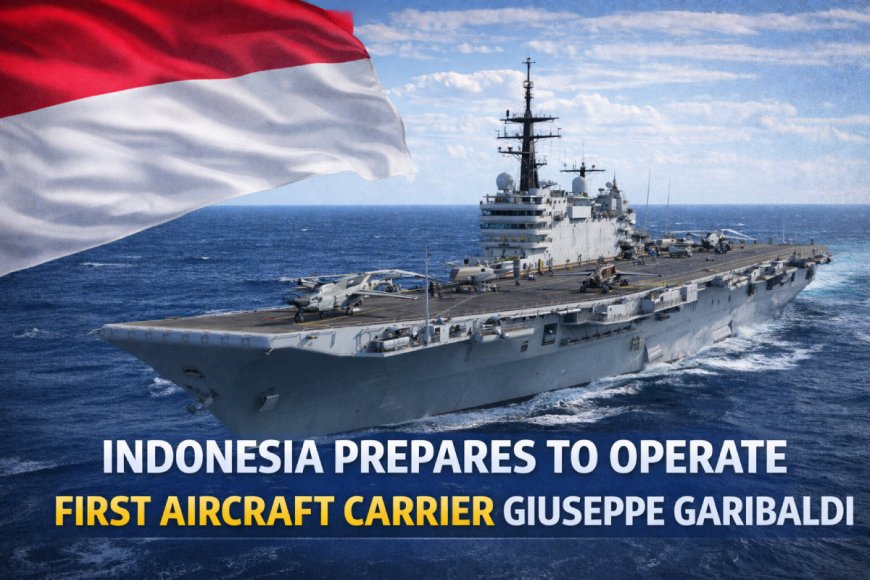
Jakarta, Feb. 13, 2026: Indonesia has taken a significant step toward operating its first aircraft carrier, the Giuseppe Garibaldi, as preparations are underway to train sailors who will crew the former Italian Navy flagship once it is officially transferred.
The Ministry of Defense confirmed on Friday that selected Indonesian Navy (TNI AL) personnel have already begun specialized training in anticipation of the vessel’s arrival.
Brigadier General Rico Ricardo Sirait, head of public relations and defense information at the Defense Ministry, said the government is ensuring that operational readiness matches the strategic importance of the acquisition.
“The Defense Ministry, together with the military, has prepared prospective crew members to sail and operate the vessel, including the necessary training and capacity-building,” Rico said in Jakarta.
Personnel Prepared for Carrier Operations
While declining to disclose the number of sailors selected or the exact location of their training, Rico emphasized that those chosen are experienced naval personnel with professional qualifications suited for advanced maritime operations.
Operating an aircraft carrier requires specialized skills, including aviation deck management, advanced navigation, aircraft handling, electronic warfare coordination, and maritime combat systems integration.
Defense analysts say the early preparation of crew members signals Indonesia’s seriousness in strengthening its naval power projection capabilities.
Transfer Still Under Negotiation
Indonesia is expected to receive the Giuseppe Garibaldi as a grant from the Italian government. However, officials clarified that the transfer will still involve substantial financial commitments.
“Giuseppe Garibaldi is a grant from the Italian government. The Indonesian government has allocated a budget for retrofit and adjustments to ensure the vessel meets the operational requirements of the Indonesian Navy,” Rico explained.
Although he did not reveal the total budget allocated, he noted that the upgrades will include modifications to propulsion systems, onboard electronics, and combat systems to align with Indonesia’s naval doctrine.
Negotiations between Indonesia and Italy remain ongoing. The discussions involve Indonesia’s Defense Ministry, Italian authorities, and Fincantieri — the shipbuilder responsible for constructing the carrier.
Only after the administrative and contractual processes are completed will full-scale technical retrofitting begin.
Targeting October 2026 Arrival
Indonesian Navy Chief of Staff Admiral Muhammad Ali recently stated that the government is aiming to finalize the transfer before October 5, 2026 — the anniversary of the Indonesian Armed Forces (TNI).
“The government, through the Defense Ministry, is still negotiating with Fincantieri and the Italian Navy regarding the transfer,” Ali said during a press briefing in Jakarta.
If the timeline holds, the carrier’s arrival would mark a historic milestone for Southeast Asia’s largest military.
Capabilities of the Giuseppe Garibaldi
The Giuseppe Garibaldi previously served as the flagship of the Italian Navy. Measuring 180.2 meters in length, the carrier can reach speeds of up to 30 knots (approximately 56 kilometers per hour).
The vessel is designed to operate fixed-wing aircraft and helicopters, significantly enhancing Indonesia’s maritime surveillance and power projection capabilities.
Its defensive systems include:
-
Mk 29 octuple launchers for Sea Sparrow or Selenia Aspide surface-to-air missiles
-
Twin 40L70 Dardo naval guns
-
Triple 324mm torpedo tubes
-
Otomat Mk 2 anti-ship missiles
-
Electronic warfare and radar jamming systems
These features provide layered defense against aerial and maritime threats, allowing the carrier to function both as a command platform and a frontline naval asset.
Strengthening Indonesia’s Blue-Water Strategy
The acquisition aligns with Indonesia’s broader defense modernization efforts aimed at expanding “blue-water” capabilities — the ability to operate effectively in open ocean environments far from home ports.
Defense officials have noted that the carrier shares design similarities with two recently commissioned Indonesian Navy vessels, KRI Brawijaya 320 and KRI Prabu Siliwangi 321, both built by Fincantieri.
This design commonality is expected to streamline maintenance procedures and accelerate crew familiarization.
Military observers say the addition of an aircraft carrier would enhance Indonesia’s strategic presence across key maritime corridors, including the South China Sea and critical international shipping routes.
Strategic Implications
Indonesia’s vast archipelagic geography makes maritime security a top national priority. The country sits along some of the world’s busiest sea lanes, including the Malacca Strait.
With growing geopolitical tensions in the Indo-Pacific region, expanding naval capabilities could improve deterrence and strengthen Indonesia’s role in regional security frameworks.
While officials emphasize that the acquisition is defensive in nature, the introduction of an aircraft carrier represents a major leap in capability for the Indonesian Navy.
The finalization of negotiations and successful retrofitting will determine how quickly Indonesia can integrate the vessel into active service.