
Prabowo Warns Entrepreneurs Against Exploiting Regulatory Loopholes for Profit
President Prabowo criticized business figures exploiting regulatory loopholes and urged stronger anti-corruption measures to boost Indonesia’s economy.
 editor
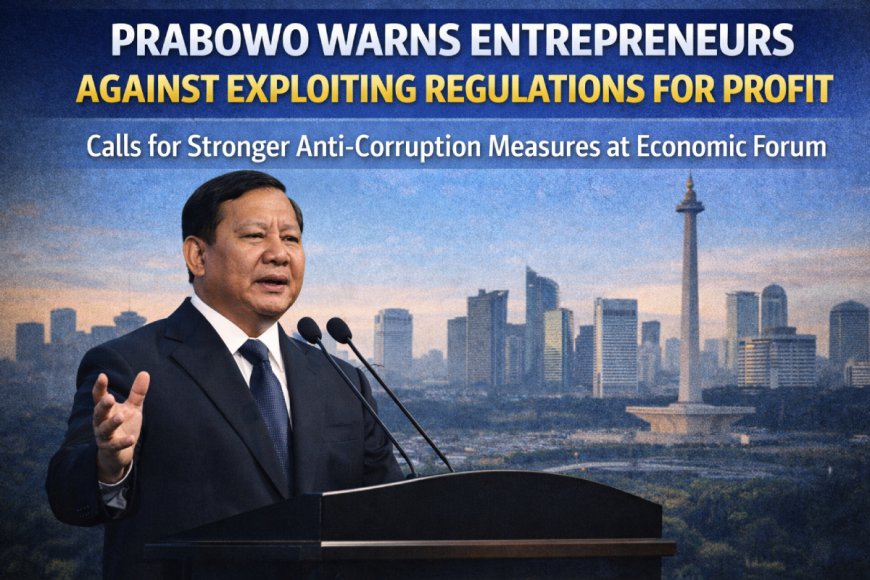
Jakarta, Feb. 13, 2026: President Prabowo Subianto delivered a strong message to Indonesia’s business community on Friday, warning entrepreneurs against manipulating regulatory loopholes for financial gain and stressing that corruption remains a major obstacle to the nation’s economic progress.
Speaking at the Indonesia Economic Outlook forum held at the Danantara building in Jakarta, Prabowo said that unethical practices involving collusion between private business figures and bureaucrats are preventing Indonesia from reaching its full economic potential.
“Corruption is still too widespread — we must clean corruption out of Indonesia,” Prabowo said in his address.
Call for Ethical Business Conduct
The president revealed that he had personally confronted several well-known entrepreneurs, many of whom he described as longtime acquaintances. Without naming individuals, Prabowo said he urged them to adhere strictly to regulations rather than attempting to bypass the system.
“I told them: your companies are already big, you’re already wealthy — just follow the rules. You’re intelligent people, but in Indonesia, intelligent people sometimes use their knowledge to game regulations,” he said.
Prabowo emphasized that Indonesia possesses vast economic resources and strong growth potential. However, he warned that sustainable development cannot be achieved without eliminating corruption at its roots.
Corruption Within Bureaucracy Also Highlighted
While criticizing private-sector misconduct, the president acknowledged that corruption is not limited to businesses alone. He said elements within the government bureaucracy also contribute to unethical practices.
“We learn from school to fight corruption. The problem is government officials must also be upright, because sometimes the misconduct comes from within the bureaucracy itself,” Prabowo stated.
His remarks underscore the administration’s broader anti-corruption stance and the need for institutional reform alongside private-sector accountability.
Closed-Door Meeting With Business Leaders
Earlier this week, Prabowo hosted a closed-door meeting at his private residence in Bogor with several of Indonesia’s most influential business leaders. During the gathering, he encouraged tycoons to prioritize investments that generate large-scale employment and deliver tangible economic benefits to the country.
The meeting included prominent conglomerate figures such as:
-
Prajogo Pangestu (Barito Pacific Group)
-
Anthony Salim (Salim Group)
-
Franky Widjaja (Sinar Mas Group)
-
Boy Thohir (Adaro Energy)
-
Sugianto Kusuma (Agung Sedayu Group)
According to the Presidential Office, the meeting was held at the request of the business leaders, who sought direct dialogue with the head of state regarding national economic challenges and opportunities.
“Indonesia Incorporated” Vision
During discussions, Prabowo emphasized closer cooperation between the government and the private sector under what he described as the “Indonesia Incorporated” framework. The concept promotes unified national collaboration to strengthen competitiveness, accelerate infrastructure development, and expand job creation.
The president called for strategic investments across key sectors, including property, energy, food production, infrastructure, plantations, and mining — industries that play a critical role in driving Indonesia’s economic performance.
He reiterated that private capital and public policy must work hand in hand, but stressed that such cooperation must remain transparent and compliant with existing laws.
Economic Reform and Growth Goals
Indonesia has been positioning itself as a rising economic power in Southeast Asia, seeking to attract foreign investment while strengthening domestic industries. However, governance concerns and regulatory inconsistencies have long been cited as barriers to faster expansion.
Prabowo’s remarks reflect an effort to reinforce investor confidence while sending a clear message that regulatory manipulation will not be tolerated under his administration.
By publicly addressing both business elites and bureaucratic misconduct, the president signaled that anti-corruption measures remain central to his economic agenda.
Observers say sustained reform efforts and strict enforcement of regulations will be crucial in translating Indonesia’s economic ambitions into measurable outcomes.