
Demis Hassabis Downplays AI’s Math Olympiad Feat, Says True General Intelligence Still Far Away
Demis Hassabis says AI systems solving Maths Olympiad problems don’t prove AGI, citing gaps in consistency and long-term learning.
 Headlines Monitor Staff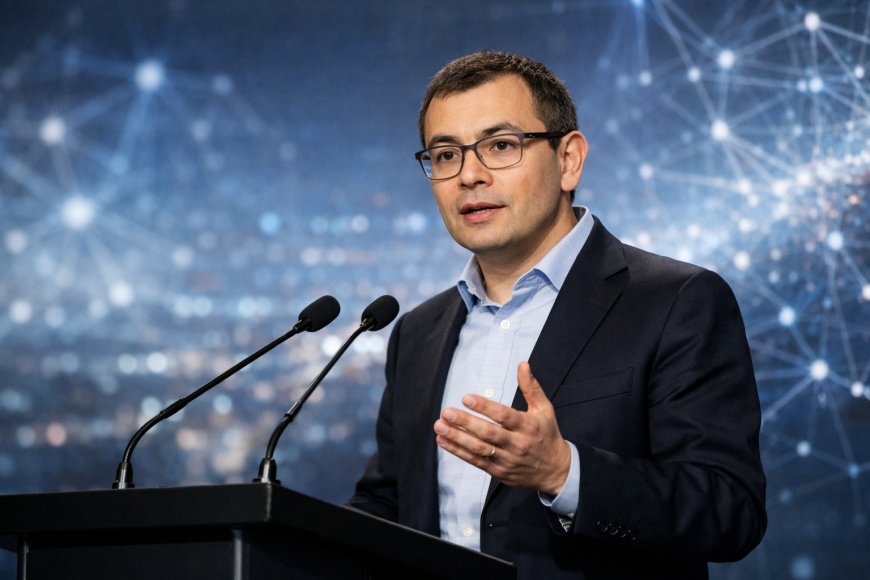
Ahmedabad, Feb. 18, 2026 — Google DeepMind CEO Demis Hassabis has cautioned against overinterpreting recent claims that advanced AI systems such as Gemini and ChatGPT can solve International Mathematics Olympiad-level problems, saying the achievement does not signal the arrival of true artificial general intelligence (AGI).
Speaking at the India AI Impact Summit 2026, Hassabis acknowledged that modern AI models have demonstrated impressive reasoning capabilities. However, he argued that their success in solving highly complex mathematical problems should not be mistaken for consistent, human-like intelligence.
“Today’s systems can get gold medals in the International Maths Olympiad — really hard problems — but sometimes they can still make mistakes on elementary maths if you pose the question in a certain way,” Hassabis said. “A true general intelligence system shouldn’t have that kind of jaggedness.”
Olympiad Success vs. Real Intelligence
Recent reports highlighting AI models achieving top-tier performance in global mathematics competitions have fueled discussions about whether machines are approaching human-level reasoning.
The International Mathematics Olympiad (IMO) is widely regarded as one of the most challenging competitions for high school students worldwide, requiring deep conceptual understanding and advanced problem-solving.
While systems such as Gemini and ChatGPT have reportedly demonstrated the ability to handle Olympiad-style reasoning tasks, Hassabis emphasized that such milestones represent narrow achievements rather than broad intelligence.
According to him, these models can excel at specific high-complexity tasks but still falter in basic scenarios when phrasing changes or context shifts slightly.
The “Jaggedness” Problem in AI
Hassabis described current AI performance as “jagged,” meaning systems can show brilliance in some tasks while failing unpredictably in others — even within the same domain.
For example:
-
AI may solve a multi-step Olympiad problem
-
Yet miscalculate a simple arithmetic question
-
Or struggle when a known problem is reformulated
This inconsistency underscores a key limitation: today’s models rely heavily on patterns learned during training rather than possessing a unified, adaptable reasoning framework.
“A general intelligence system should not display that kind of unevenness,” Hassabis noted.
What Today’s AI Models Lack
Hassabis outlined several core limitations that prevent current systems from reaching AGI.
1. No Continuous Learning
Most AI systems are “frozen” after training. Once deployed, they do not continuously learn from real-world interactions unless retrained offline.
In contrast, human intelligence evolves dynamically through experience.
2. Limited Long-Term Planning
AI can execute short-term tasks efficiently but struggles with coherent strategies spanning years or decades.
True AGI, according to Hassabis, would require sustained, long-horizon reasoning.
3. Domain Fragility
Even within mathematics or coding, AI can excel in one context but fail in another. This inconsistency indicates that reasoning is not yet generalized.
Beyond Math: AI’s Role in Healthcare
While cautioning against AGI hype, Hassabis also expressed optimism about AI’s practical applications — particularly in medicine.
In recent remarks, he described healthcare as one of AI’s most transformative frontiers.
“One of the most important things we can use AI for is to improve human health,” Hassabis wrote in a post on X.
He pointed to drug discovery as a domain where AI can dramatically reduce timelines and costs.
Traditional biotech firms may develop one or two drugs over their lifetime. Hassabis said the goal at Isomorphic Labs — a biotech venture he co-founded — is to build systems capable of developing dozens of medicines annually.
“That seems crazy right now,” he told Fortune. “But eventually, over the next 10 to 20 years, we could get to finding solutions to all disease… if we have a process that can find these needles in a haystack.”
AI Hype vs. Reality
Hassabis’ remarks come at a time when the global AI sector is experiencing intense investment and public attention.
Recent breakthroughs in generative AI, large language models and reasoning systems have led some observers to speculate that AGI may be near.
However, researchers remain divided on timelines.
Hassabis’ comments reflect a more measured perspective: impressive benchmarks do not equate to holistic intelligence.
Experts note that while AI systems may outperform humans in narrow tasks, they still lack:
-
True understanding
-
Autonomous long-term learning
-
Robust reasoning across varied environments
-
Common-sense world modeling
India’s Growing AI Role
The India AI Impact Summit 2026 highlighted India’s expanding role in global AI research and infrastructure development.
With increasing investment in AI data centres, sovereign compute capacity and research programs, India is positioning itself as a key player in the next wave of technological innovation.
Hassabis’ participation at the summit underscores the strategic importance of AI collaboration between global tech leaders and emerging markets.
What Happens Next?
The conversation around AGI is likely to intensify as AI systems continue improving.
In the near term:
-
AI companies will focus on making models more reliable and consistent
-
Research will advance toward continual learning architectures
-
Healthcare applications may accelerate commercialization
-
Policymakers will continue debating regulation and safety frameworks
Hassabis’ remarks suggest that while AI has achieved notable breakthroughs, researchers remain aware of fundamental gaps.
The next frontier, he says, lies in systems that can learn continuously, reason consistently, and adapt dynamically — qualities that define true intelligence.
Until then, Olympiad-level math performance remains a milestone, not a finish line.